
Blog
Therapy for Relationship Anxiety: Signs You Have It and How to Calm the Spiral
Rachel Grant · October 21, 2026
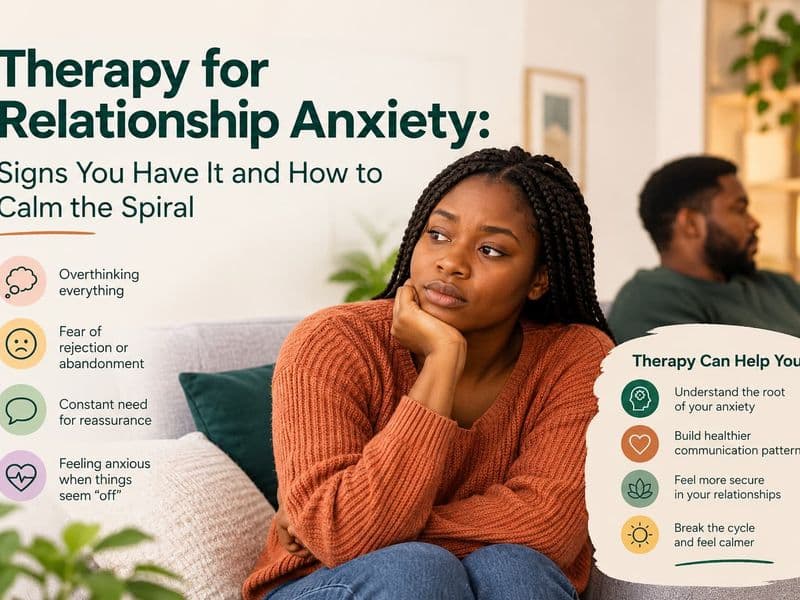
What is relationship anxiety?
Relationship anxiety is persistent worry, doubt, or insecurity about a romantic relationship, even when nothing is clearly wrong. It often shows up as overthinking, needing constant reassurance, and fearing rejection or abandonment. It isn't a formal diagnosis on its own, but it responds well to therapy, especially cognitive behavioural therapy (CBT) and attachment-based approaches.
A little nervousness in a relationship is normal. Butterflies on a first date aren't anxiety.
The difference? Relationship anxiety tends to stick around after the newness fades, and it doesn't match what's actually happening between you and your partner.
In this guide, you'll learn:
- The 10 most common signs of relationship anxiety
- How to tell relationship anxiety from relationship OCD and from genuine red flags
- Why the anxiety spiral keeps repeating (and why reassurance makes it worse)
- 7 practical ways to calm the spiral tonight
- Which types of therapy for relationship anxiety work, and how to find a therapist in Canada
10 signs of relationship anxiety
No two people experience it the same way. But these patterns show up again and again:
- Overanalyzing texts, tone, and small changes. A shorter reply or a flat "ok" sends you searching for hidden meaning.
- Needing constant reassurance. You ask "Are we okay?" or "Do you still love me?" again and again, and the relief never lasts.
- Fearing abandonment. You're braced for your partner to leave, even without any sign of it.
- Expecting things to fall apart. The relationship feels "too good to be true," so you wait for the other shoe to drop.
- Checking and monitoring. You scroll their social media, check when they were last online, or track their location.
- Jealousy and comparison. You compare your relationship with friends' relationships, past partners, or an idealized version of love.
- Mind-reading and catastrophizing. One unanswered call becomes "they're done with me."
- Pulling away or avoiding closeness. You dodge deep conversations or relationship milestones because getting hurt feels unbearable.
- Looking for reasons to leave, or sabotaging. You pick fights or end things first so you don't get left.
- Hidden signs: people-pleasing, perfectionism, and over-functioning. You work overtime to be "good enough" and avoid any conflict.
Like other forms of anxiety, it can also show up in your body: a racing heart, a knot in your stomach, trouble sleeping.
If you recognized yourself in three or more of these, and they've been going on for weeks or months, it's worth paying attention.
Is it relationship anxiety, or is something actually wrong?
This is the question that keeps people up at night. So let's make it clearer.
Relationship anxiety doesn't automatically mean you're in an unhealthy relationship or with the wrong person. Often, it's more about your past and how you see yourself than about the partner in front of you.
Relationship anxiety
A genuine relationship problem
Where the worry comes from
Fears and "what ifs," often with no clear trigger
Specific things that happened (dishonesty, disrespect, control)
Does it follow you?
Yes. It shows up in past relationships too
Usually tied to this one relationship
After an honest talk
Brief relief, then doubt returns
Concerns get acknowledged and something changes (or doesn't)
How it feels
Dread, even when things are going well
Hurt, anger, or distrust tied to real events
One important exception: if you ever feel unsafe, controlled, or afraid of your partner, that's not anxiety. Contact local emergency services (911) or a support line in your province.
Relationship anxiety vs. relationship OCD (ROCD)
Sometimes the doubt goes deeper than ordinary worry.
Relationship OCD (ROCD) is a subtype of obsessive-compulsive disorder. It involves intrusive, unwanted doubts ("Do I really love them?" "Is this the right person?") followed by compulsions such as seeking reassurance, mentally replaying conversations, testing your feelings, comparing, or researching the question online.
The key difference is how much time and energy it consumes. Someone with a milder case might spend an hour a day stuck in it. Someone with a more severe case might spend several.
Why does this matter? Because with ROCD, the instinctive fixes (analyzing the doubt, asking for reassurance, taking a break to "find out how you feel") are the compulsions that keep it going. ROCD responds to a specific type of treatment, so a proper assessment from a clinician is worth it.
You can't diagnose this from an article. But if the doubts are unwanted and repetitive, and they get louder when things are going well, talk to a mental health professional.
What causes relationship anxiety?
Experts don't point to a single cause. It's usually a mix of the following:
- Past relationship experiences. Infidelity, abuse, or a painful breakup can teach your brain to expect the worst.
- Attachment style. People with an anxious attachment style tend to experience relationship anxiety more than people with other styles. Early experiences shape how your nervous system handles uncertainty in close relationships.
- Past trauma. Earlier hurts can make safety in love feel fragile.
- Low self-worth. If part of you believes you don't deserve this person, you'll keep waiting for them to figure it out.
- Life transitions. Moving in together, getting engaged, marriage, or pregnancy can all raise the stakes.
- An existing anxiety disorder. Generalized anxiety or social anxiety can spill over into your relationship.
- Gaps in communication or emotional availability. When you don't know where you stand, anxiety fills in the blanks.
Why the spiral keeps going (and why reassurance backfires)
Here's the part most people don't realize.
Relationship anxiety isn't just a feeling. It's a loop:
- A trigger. Your partner is quiet, late to reply, or distracted.
- A scary thought. "They're losing interest."
- A spike of anxiety. Your heart races. Your mind speeds up.
- A safety behaviour. You check their phone, ask for reassurance, pick a fight, or withdraw.
- Short-term relief. For a moment, you feel better.
- The doubt returns, stronger. Your brain learned that the thought was dangerous and that the checking "worked." So the next trigger hits harder.
Then you're back to step 1.
That's why reassurance feels so good in the moment and so empty an hour later. It soothes the anxiety briefly, but over time it strengthens the cycle.
The good news? Loops can be broken. And that's exactly what the next section is about.
How to calm the relationship anxiety spiral: 7 techniques
These won't replace therapy. But they can help you interrupt the loop in the moment.
- Name it. Say it to yourself: "This is anxiety talking." Try phrasing the thought as "I'm having the thought that they're losing interest," instead of "They're losing interest." That small gap gives you room to breathe.
- Separate the facts from the story. Write two columns: What actually happened and What my mind added. "They haven't replied in three hours" is a fact. "They're done with me" is a story.
- Ground your body first. Anxiety lives in the body, so start there. Breathe in for 4 and out for 6, a few times. Or name five things you can see, four you can touch, three you can hear.
- Delay the urge to seek reassurance. Don't fight the urge. Postpone it. Wait 20 minutes, do something else, and notice that the wave rises and falls without you doing anything.
- Ask for what you need, once, directly. There's a difference between testing your partner and telling them. Try: "I'm feeling a bit insecure tonight. Could we have a quick check-in?" One honest request is healthy. Ten rephrased versions of the same question is the loop.
- Reduce the checking. Mute the notifications, stop scrolling their profiles, turn off location tracking, and close the tab where you're Googling "signs they're losing interest." Every check feeds the cycle.
- Invest in your own life. Sleep, movement, friends, hobbies, and goals that have nothing to do with your relationship. The more your sense of worth is spread across your life, the less any single text can shake it.
A note on ROCD: if your doubts feel intrusive and repetitive, then mentally reviewing, comparing, and seeking reassurance may be compulsions, not coping tools. In that case, self-help only goes so far. A therapist trained in OCD treatment can help.
Therapy for relationship anxiety: what works
Self-help can take you far. But if the spiral keeps coming back, therapy gives you something a list of tips can't: a trained person who helps you understand your patterns and change them.
Here are the main approaches:
- Cognitive behavioural therapy (CBT). CBT helps you spot anxious thoughts, test them against reality, and gradually drop the safety behaviours (checking, seeking reassurance) that feed the loop. In one randomized trial of 495 people with social anxiety disorder, CBT led to significant changes in attachment anxiety and avoidance right after treatment, though by the one-year follow-up the gap with short-term psychodynamic therapy had largely closed.
- Attachment-based therapy. This approach looks at the early relationship patterns that shaped how you handle closeness, then helps you build more secure ways of relating.
- Acceptance and Commitment Therapy (ACT) and mindfulness-based therapy. These teach you to notice anxious thoughts without obeying them, so you can tolerate uncertainty without acting on every worry.
- Exposure and response prevention (ERP). The gold-standard approach for relationship OCD. You practise sitting with the feared thought ("maybe I don't love them") without checking, reassurance-seeking, or avoiding.
- Couples therapy. When anxiety is affecting both of you, approaches like Emotionally Focused Therapy (EFT) and the Gottman Method help you break the pursue-and-withdraw pattern together.
- Medication. If your relationship anxiety is part of a broader anxiety disorder, a doctor may discuss medication alongside therapy.
What to expect in therapy
A good therapist will start by getting to know your story: when the anxiety shows up, what triggers it, and what you do to cope. Then you'll work on practical skills together, and on the deeper beliefs underneath ("I'm not enough," "people leave").
Which approach is best? It depends on you. Many therapists blend methods, and research consistently shows the relationship between you and your therapist matters a great deal. Look for someone you feel safe and understood with.
When to see a therapist for relationship anxiety
You don't need to wait for a crisis. But it's a good time to reach out if:
- The worry takes up hours of your day or keeps you awake at night
- You keep having the same fight, or the same fear, in every relationship
- You check, test, or seek reassurance compulsively and it's straining your relationship
- Your doubts get louder when things are going well
- You're avoiding closeness or thinking about ending things mainly because of the anxiety
- It's affecting your work, sleep, or ability to be present with your partner
If you're in crisis or thinking about harming yourself, call or text 9-8-8, Canada's Suicide Crisis Helpline, any time.
How to find the right therapist in Canada
Mental health professions are regulated province by province, so titles differ depending on where you live. Here's how to choose with confidence:
- Check the title and the college. Psychologists, registered psychotherapists (regulated in Ontario and Quebec), counselling therapists, and registered social workers are all regulated in different parts of the country. Look your therapist up on their provincial college's public register.
- Match the specialty to your need. Ask whether they treat anxiety, attachment issues, or OCD (if you suspect ROCD), and which methods they use.
- Make sure they're registered in your province. This matters especially for online therapy.
- Check your benefits. Many extended health plans cover psychologists, and coverage for registered psychotherapists keeps growing. Ask your insurer what's covered and how much you can claim.
- Pay attention to the first session. Do you feel heard, safe, and understood? Fit matters.
Not sure whether you need a psychologist or a psychotherapist? Read our guide: Psychotherapist vs Psychologist: Which One Do You Need?.
Frequently asked questions about relationship anxiety
Is relationship anxiety a mental illness?
Relationship anxiety isn't a formal diagnosis on its own. But it can be part of a recognized condition such as generalized anxiety disorder, social anxiety disorder, or relationship OCD. A mental health professional can help you figure out which applies to you.
Can therapy help with relationship anxiety?
Yes. Therapy helps you identify your triggers, challenge anxious thoughts, build coping skills, and communicate your needs. Many people see real improvement, and the goal is to loosen anxiety's grip so your relationship can feel safer.
What is the best therapy for relationship anxiety?
CBT, attachment-based therapy, and mindfulness or acceptance-based therapy are commonly used. If the doubts are obsessive and compulsive (ROCD), exposure and response prevention is the specialized option. The best choice depends on your history and goals.
Does relationship anxiety mean I'm with the wrong person?
Not necessarily. Relationship anxiety is often about your past and your self-image more than your partner. If you've felt this way in earlier relationships too, that's a clue. A therapist can help you sort out what's anxiety and what's real.
How do I stop overthinking in my relationship?
Name the thought as anxiety, separate facts from the story, delay the urge to seek reassurance, and cut back on checking behaviours. If overthinking keeps coming back, therapy can help you break the pattern.
How can I support a partner with relationship anxiety?
Be patient and kind, but avoid getting pulled into endless reassurance loops, because they can strengthen the anxiety over time. Gently encourage professional support, and ask how you can help rather than guessing.
How is relationship anxiety different from relationship OCD?
Relationship anxiety is general worry and insecurity about the relationship. ROCD involves intrusive doubts plus compulsive behaviours (reassurance-seeking, checking, mental reviewing) that take up a lot of time and make the doubt grow. ROCD is a subtype of OCD and needs OCD-specific treatment.
You don't have to spiral alone
Relationship anxiety can make you feel like you're always one text away from losing everything.
But it's a pattern, not a verdict. And patterns can change.
If you're ready to understand your anxiety and feel more secure in your relationships, Balance Self Care is here to help. Book a Session Now!
You've already taken the first step by reading this far.
This article is for general information and isn't a substitute for professional advice, diagnosis, or treatment. If you're in crisis, call or text 9-8-8 any time.