
Blog
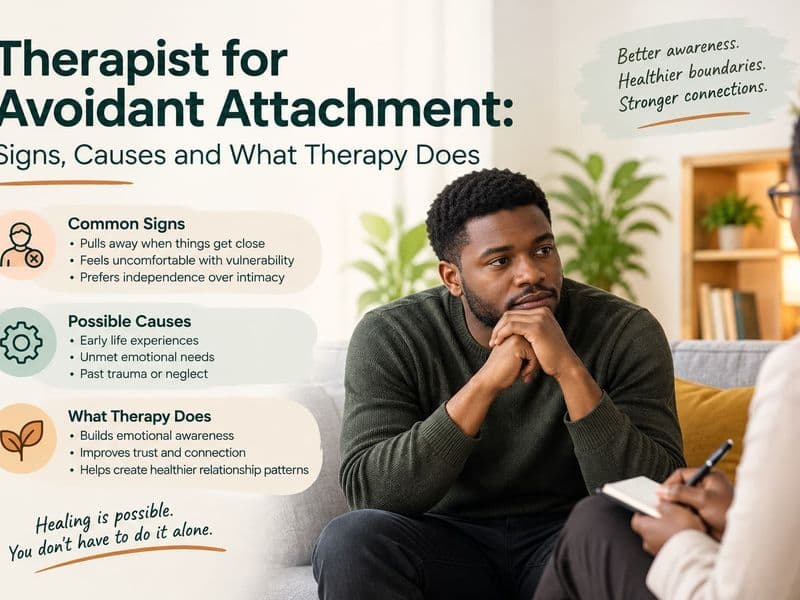
Therapist for Avoidant Attachment: Signs, Causes and What Therapy Does
Rachel Grant · October 20, 2026
You love them. You really do.
But the moment they say "I need you" or "Can we talk about us?", something in you steps back.
You suddenly need space. Work gets busy. The relationship starts to feel like a room with the walls moving in.
And then you wonder: What is wrong with me?
Nothing is “wrong” with you. You may have an avoidant attachment style, a pattern of keeping distance that once protected you. And the right therapist can help you change it.
What is avoidant attachment?
Avoidant attachment is an insecure attachment style in which a person keeps emotional distance, prizes independence, and feels uncomfortable with closeness or relying on others. It usually forms in childhood, often when caregivers were emotionally unavailable. It isn't a mental illness or a diagnosis. A therapist who specializes in avoidant attachment can help you understand the pattern and build safer closeness, using approaches such as attachment-focused therapy, emotionally focused therapy (EFT), schema therapy, and CBT.
How common is it? In a nationally representative U.S. study of adults, about 25% had an avoidant attachment style, compared with 59% secure and 11% anxious. That's roughly one in four people.
So you're far from alone.
And here's the encouraging part: attachment styles aren't set in stone. With the right support, people can become more secure over time.
In this guide, you'll learn:
- The 10 most common signs of avoidant attachment (and how it differs from introversion)
- What causes it, and why it isn't anyone's "fault"
- How the pull-and-retreat cycle plays out in relationships
- What therapy for avoidant attachment actually involves, step by step
- How to find the right therapist in Canada
10 signs of avoidant attachment
The signs aren’t always loud. They often show up in small habits, quiet reactions, and an instinct to rely on yourself first.
- Fierce self-reliance. You’d rather struggle alone than ask for help. Needing someone feels uncomfortable, even risky.
- Unease when things get emotionally real. A heartfelt conversation makes you tense, restless, or eager to change the subject.
- Downplaying your feelings. "I'm fine" is your default. You may not even be sure what you feel.
- Pulling away as closeness grows. After a great weekend together, you suddenly need space.
- Struggling to prioritize the relationship. You're technically in it, but with one foot near the door.
- Seeing vulnerability as a weakness. Opening up feels like handing someone a weapon.
- Zeroing in on your partner's flaws. When things get close, small annoyances loom large.
- Withdrawing during conflict. You go quiet, leave the room, or shut down when emotions run high.
- Keeping things casual, or avoiding milestones. Moving in, commitment talks, or "what are we?" conversations make you stall.
- Looking calm and confident on the outside. Your partner often can't tell what you feel, because you don't show it.
If you recognized yourself in several of these, it doesn't mean you can't love. People with avoidant attachment want connection like anyone else. Avoidance is a distance strategy built early to protect against a relationship environment that felt unreliable.
How the four attachment styles compare
Researchers describe adult attachment along two dimensions: anxiety about the relationship and avoidance of closeness. That's what separates the styles:
[TABLE --- INCOMING]
"I want you, but this feels dangerous."
That last pair is often confused. A dismissive-avoidant person pulls away because they genuinely feel they don't need much from anyone. A fearful-avoidant person craves closeness but fears getting hurt.
Is avoidant attachment the same as being an introvert?
No. Introversion is about where you get your energy: quiet time recharges you. Avoidant attachment is about discomfort with emotional closeness and dependence. An introvert can be deeply open and intimate with a partner. Someone with an avoidant attachment style can be the life of the party and still keep everyone at arm's length.
Is avoidant attachment a personality disorder?
No. You'll sometimes see "dismissive-avoidant personality disorder" online, but attachment styles are patterns of relating, not diagnoses. (Avoidant personality disorder is a separate condition, centered on social inhibition and fear of criticism.) A mental health professional can help if you're unsure which you're dealing with.
What causes avoidant attachment?
The honest answer: researchers say the causes aren't fully clear. But several patterns keep coming up.
- Emotionally distant, rigid, or dismissive caregivers. When a child's emotional needs were brushed aside, they learn that reaching out doesn't bring comfort.
- Overly intrusive caregivers. Too much control or smothering can teach a child that closeness means losing yourself.
- Needs that went unmet again and again. The child adapts by becoming self-sufficient and hiding feelings, because that keeps the peace.
- Childhood adversity. In a large national study, interpersonal childhood adversity was strongly linked to insecure adult attachment, as were parental substance abuse, divorce, and financial hardship.
- A parent's own attachment style. Patterns can be handed down across generations.
- Temperament and later experiences. Some children are naturally more reserved, and later hurts (or having independence rewarded) can reinforce the pattern.
This isn't about blaming your parents
The same research found that insecure attachment doesn't come simply from having had poor relations with your parents. Many caregivers did their best with what they had.
Think of avoidance as a clever solution to a hard problem. A child who learns "I'm safer when I don't need anyone" is adapting to their environment. The strategy worked then. The trouble is that it keeps running long after it stops being useful.
Why avoidant attachment matters: the pull-and-retreat cycle
In relationships, avoidance rarely acts alone. It often pairs with a partner who craves more closeness, and the two fall into a familiar dance:
- Your partner reaches for more closeness or reassurance.
- You feel crowded, pressured, or "needed" in a way that's hard to meet.
- You pull back: more work, more space, more silence.
- Your partner feels rejected and reaches harder.
- You feel even more crowded, and withdraw further.
Then it all begins again.
The result? A partner feels shut out, and you feel smothered, both trying to feel safe in opposite ways.
Over time, avoidant patterns can leave you lonely even in a relationship, strain trust, and stall closeness. Researchers have also found that secure adults tend to have better mental health outcomes, and that insecure attachment is linked with a range of psychological difficulties.
Why starting therapy can feel hard
Here's something worth knowing. Research suggests that avoidant attachment is linked to less willingness to seek psychotherapy and less self-disclosure with therapists.
So if the idea of talking to a therapist makes you want to close the tab, that's not a flaw. It's the pattern showing up. And a good therapist for avoidant attachment expects it, and works at your pace.
It may be time to seek support if:
- Relationships end or stall whenever they get closer
- Partners often say they can't tell what you feel, or that you shut them out
- You feel lonely or numb but can't explain why
- You pull away or pick fights as soon as things get serious
- You want closeness but don't know how to let it in
What therapy does for avoidant attachment
A therapist for avoidant attachment doesn't try to turn you into someone who needs everyone. The goal is to loosen the old "don't need anyone" rule so you can have closeness and keep your independence.
Therapy approaches that help
- Attachment-focused psychotherapy. This explores your early experiences and current relationship patterns, and the therapy relationship itself becomes a safe place to practise closeness. Research suggests that clients with avoidant pre-therapy attachment who "earn" a secure attachment to their therapist appear to benefit more from therapy.
- Emotionally focused therapy (EFT). EFT helps you recognize, name, and express emotions and needs, and creates safe, corrective emotional experiences, either individually or with a partner. In a controlled study of couples, 12 sessions of EFT or schema mode therapy both increased secure attachment and reduced avoidant attachment.
- Schema therapy. It targets the deeper, long-standing life patterns and beliefs that keep avoidance going.
- Cognitive behavioural therapy (CBT). CBT challenges beliefs like "intimacy is risky" or "needing people is weak." In a trial of 495 people with social anxiety disorder, CBT was linked to significant changes in attachment anxiety and avoidance by the end of treatment.
- Mindfulness-based therapy and ACT. You practise noticing the urge to withdraw without automatically obeying it.
- EMDR (for trauma). If painful early experiences sit underneath the pattern, trauma-focused work may be part of the plan.
- Couples therapy. When your partner is part of the dance, working on it together can break the pull-and-retreat cycle.
What therapy looks like, step by step
Every therapist works differently, but a typical path looks like this:
- Mapping the pattern. You and your therapist trace when you pull away, what triggers it, and what it protects you from.
- Building emotional awareness. Many people with avoidant attachment learned to suppress feelings so early they can't name them. You'll practise noticing what you feel and where you feel it.
- Practising closeness in small, safe steps. This often starts right in the therapy room, at a pace that doesn't feel overwhelming.
- Changing what you do in real life. For example, staying in a hard conversation a little longer, or saying "I need a break, and I'll come back in an hour," instead of vanishing.
- Rewriting the underlying beliefs. "I'm safer alone" gradually becomes "I can let people in and still be me."
Nobody will force you to open up before you're ready. Good therapy respects your need for autonomy.
Can avoidant attachment really change?
Yes. Psychologists call it earned secure attachment: becoming secure after starting out insecure. A qualitative study of people who made this shift found that it took intentional effort, wasn't a straight line (setbacks happened), and often involved therapy and other safe relationships such as friends, mentors, or a partner.
In other words: it won't happen by accident. But it can happen.
How to find a therapist for avoidant attachment in Canada
In Canada, mental health professions are regulated province by province, so titles differ depending on where you live. Here's how to choose well:
- Check the title and the college. Psychologists, registered psychotherapists (regulated in Ontario and Quebec), counselling therapists, and registered social workers are regulated in different parts of the country. Look your therapist up on their provincial college's public register.
- Look for relevant training. Ask about attachment-based therapy, EFT, schema therapy, or CBT, and experience with people who find closeness difficult.
- Ask the right questions. Try these in a first call:
- "How do you work with people who find emotional closeness hard?"
- "What approach do you use, and why?"
- "How do you pace sessions, and what happens if I feel overwhelmed or want to pull back?"
- "Can my partner join if we need that later?"
- Make sure they're registered in your province. This matters especially for online therapy.
- Check your benefits. Many extended health plans cover psychologists, and coverage for registered psychotherapists keeps growing. Ask your insurer what's covered.
- Trust how the first session feels. Do you feel respected, unhurried, and understood? Fit matters a lot, especially if opening up doesn't come easily.
Not sure whether you need a psychologist or a psychotherapist? Read: [Psychotherapist vs Psychologist: Which One Do You Need?] (add the internal link here). If you also deal with constant worry in your relationship, see: [Therapy for Relationship Anxiety] (add the internal link here).
If you're in crisis or thinking about harming yourself, call or text 9-8-8, Canada's Suicide Crisis Helpline, any time.
Frequently asked questions about avoidant attachment therapy
What kind of therapist is best for avoidant attachment?
Look for a regulated professional (a psychologist, registered psychotherapist, counselling therapist, or registered social worker, depending on your province) with training in attachment-based therapy, EFT, schema therapy, or CBT, and experience working with people who find closeness difficult.
Can therapy help with avoidant attachment?
Yes. Therapy helps you understand where the pattern comes from, name and express feelings, and practise closeness at a pace you can handle. Research on earned secure attachment shows that people with insecure attachment can become more secure over time, often with therapy and other supportive relationships.
Can avoidant attachment be healed or changed?
It can change. The shift to earned secure attachment usually takes intentional effort and isn't a straight line, but many people get there. The goal isn't to erase your independence. It's to be able to let people in as well.
Is avoidant attachment a mental disorder?
No. It's a pattern of relating, not a diagnosis. It can occur alongside conditions such as anxiety or depression, and a professional can help sort out what's what.
What's the difference between dismissive-avoidant and fearful-avoidant attachment?
A dismissive-avoidant person tends to feel "I don't need you." A fearful-avoidant person feels "I want you, but this feels dangerous." Fearful-avoidant (also called disorganized) attachment combines anxious and avoidant tendencies.
Can someone with avoidant attachment love deeply?
Absolutely. People with avoidant attachment want connection like anyone else. They may just show it differently, or struggle to let it be seen.
How long does therapy for avoidant attachment take?
There's no single timeline. Change tends to be gradual and non-linear, and it depends on your history, your goals, and the approach. Your therapist can give you a realistic sense after getting to know you.
Will therapy take away my independence?
No. Good therapy doesn't ask you to become dependent. It helps you move toward a balance where you can be close to others and still feel like yourself.
How can I support a partner with an avoidant attachment style?
Stay calm and direct, avoid pressure and ultimatums, and give space without disappearing. Make clear, specific requests rather than broad demands for "more openness," and gently encourage professional support, such as couples therapy.
Ready to let someone in, at your own pace?
Avoidant attachment isn't a life sentence. It's a strategy you learned a long time ago, and strategies can be updated.
If you'd like support understanding your patterns and building closeness without losing yourself, Balance Self Care is here to help. Book a Session
You don't have to open up all at once. You only have to take the first step.
This article is for general information and isn't a substitute for professional advice, diagnosis, or treatment. If you're in crisis, call or text 9-8-8 any time.