
Blog
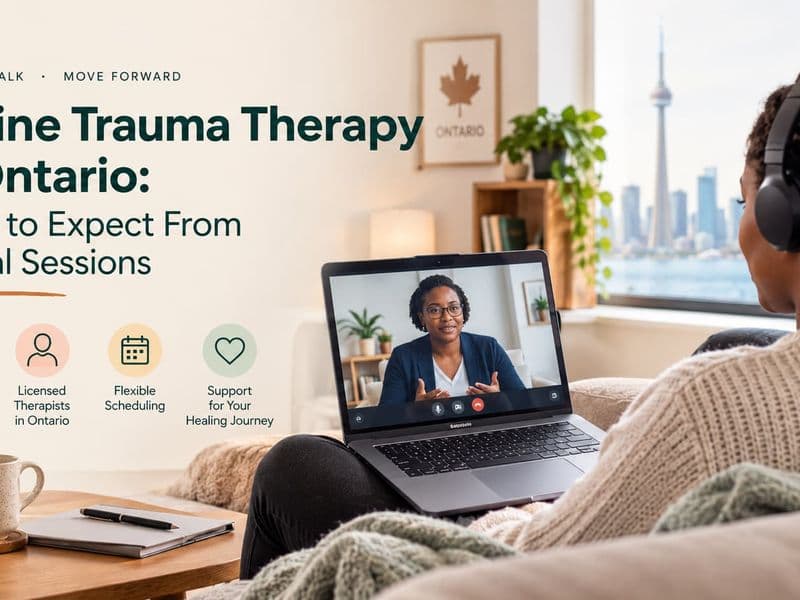
Online Trauma Therapy in Ontario: What to Expect From Virtual Sessions
Rachel Grant · October 21, 2026
Maybe it happened years ago. Maybe it was last month.
Either way, it still follows you: the jolt at a sudden sound, the nights that won't go quiet, the feeling that you're never quite safe, even when you are.
You've been thinking about getting help. And then the practical questions pile up.
Can trauma therapy really work through a screen? Is it safe to do this at home? What actually happens in a virtual session? Will I have to relive everything?
These are fair questions. And you deserve clear answers before you take the first step.
What is online trauma therapy in Ontario?
Online trauma therapy in Ontario is trauma-focused psychotherapy delivered through secure video sessions by a therapist registered with an Ontario regulatory college. It uses the same evidence-based approaches as in-person care, such as EMDR, cognitive processing therapy (CPT), and prolonged exposure, and can help with PTSD and the lasting effects of distressing events, from the privacy of your own space.
The short version: the therapy itself is the same. What changes is where you sit, and a few extra steps to make sure you feel safe while you do the work.
In this guide, you'll learn:
- Whether online trauma therapy works (and what the research says)
- Which trauma therapies can be done virtually
- What to expect, step by step, from your first call to ongoing sessions
- How to set up a safe, private space at home
- Ontario-specific details: who can treat trauma, what it costs, and what's covered
- Who online therapy is right for, and when you may need more support
Does online trauma therapy work?
For the most-studied trauma treatments, the research is encouraging: video-based therapy has produced results comparable to in-person care.
Study
What was tested
What it found
Randomized trial of rural veterans with PTSD
Cognitive processing therapy (CPT) by video vs in person
Video was "noninferior" (as good as) in-person. PTSD symptoms dropped significantly after treatment, and the gains held at 3 and 6 months. Therapy relationship and satisfaction were similar in both groups.
Randomized trial of 207 veterans
CPT by video vs in person
CPT by video can be as effective as in-person for reducing PTSD symptoms.
Canadian study of CBT for PTSD (Montreal)
Face-to-face vs videoconference CBT, six-month follow-up
Researchers concluded videoconference CBT is a viable alternative when face-to-face treatment is less available.
Research on EMDR by video
Videoconference-based EMDR
Newer and smaller. Studies suggest it's feasible, but the evidence base isn't yet as large as for CPT or CBT.
Two honest caveats:
- Many of these studies involved veterans. The results are encouraging, but they don't automatically apply to everyone.
- Trauma-focused therapy can be demanding. A systematic review found that dropout from trauma-focused treatments was higher than from other therapies for PTSD. That's why pacing and a good therapeutic relationship matter so much, whether online or in person.
And there's another benefit that doesn't show up in effectiveness numbers: access. For many people in Ontario (in rural and northern communities, with mobility challenges, or juggling work and caregiving), online therapy is what makes trauma treatment possible at all.
Trauma therapies that work online
Treatment guidelines consistently describe trauma-focused psychotherapy as the first-line psychological treatment for PTSD. A large systematic review of 114 randomized trials (more than 8,000 participants) found robust evidence for trauma-focused CBT and EMDR, with cognitive processing therapy (CPT), cognitive therapy, and prolonged exposure (PE) among the strongest.
Here's how the main approaches work, and how they adapt to a screen:
- Cognitive processing therapy (CPT). CPT helps you examine the beliefs that trauma left behind ("it was my fault," "the world isn't safe," "I can't trust anyone") and reappraise them. It relies on talking and written exercises, so it translates easily to video. It's typically delivered over around 12 sessions.
- Prolonged exposure (PE). PE helps you gradually approach memories and situations you've been avoiding, at a pace you can handle, so fear loosens its grip. It includes education about common trauma reactions and practice between sessions.
- Trauma-focused CBT. This approach addresses the thoughts, feelings, and memories connected to the event, and builds coping skills along the way.
- EMDR (eye movement desensitization and reprocessing). EMDR helps your brain reprocess memories that feel "stuck." In online sessions, the bilateral stimulation (the back-and-forth eye movements, sounds, or taps used in EMDR) is adapted: your therapist may use an on-screen moving light, audio tones, or self-tapping. Therapists may also spend extra time on grounding in virtual sessions to make sure you feel safe. Research on EMDR by video is newer than for CPT or CBT, so ask your therapist how they deliver it.
- Other approaches. Somatic (body-based) work, parts-based therapy, and mindfulness are often used alongside these approaches. Their research base is smaller, so many therapists use them as complements rather than replacements.
What if you'd rather not do trauma-focused therapy? When it isn't available or isn't your preference, guidelines also recommend options like medication (a doctor can advise) or non-trauma-focused therapies such as present-centred therapy, stress inoculation training, or interpersonal therapy.
Which is best? Research doesn't show one trauma-focused therapy clearly outperforming the others. The best fit depends on you, your history, and your therapist's training.
What to expect from virtual trauma therapy, step by step
Every therapist works a little differently. But here's a typical path:
- Before you book. Many therapists offer a short consultation call. Use it to ask about their registration, their trauma training, and how they work online. You'll usually sign consent forms and review how your information is kept private.
- Your first session (intake). Expect questions about what brings you in, what you'd like to change, and your current life. You decide how much of your story to share. You don't need to describe the details of what happened. Your therapist may also ask you to complete a few symptom questionnaires, and will typically confirm your location and an emergency contact, since you're attending from home.
- Building stability first. Early sessions often focus on skills: grounding, calming your body, sleep, and coping with triggers. Think of it as laying the ground before building. You and your therapist agree on a plan for what to do if you feel overwhelmed or "checked out" mid-session.
- Doing the trauma work. Once you're ready, you begin your chosen approach (CPT, PE, EMDR, or trauma-focused CBT). Sessions are usually 50 to 60 minutes, and EMDR sessions are sometimes longer. Some therapies, like prolonged exposure, involve revisiting memories. You and your therapist set the pace together, and you can pause at any time.
- Winding down after each session. Good therapists leave time to settle your body and mind before the session ends, so you're not logging off mid-wave.
- Integration and wrapping up. As symptoms ease, sessions focus on consolidating gains, handling future triggers, and planning for the long run. Therapy ends when you're ready, not on a fixed timeline.
What a virtual session looks like
You'll connect with your therapist by secure video, usually from a private room. Your therapist watches your expression and body language on screen, checks in often, and may guide breathing or grounding exercises. If the connection drops, they'll have a backup plan, typically a phone call.
It's also normal to need a little time to adjust. Many people say that after a session or two, the screen fades into the background.
How to set up for safe, private virtual sessions
Trauma work asks a lot of your nervous system. A little preparation makes the space feel safer.
Before each session:
- Choose a private, quiet space. Somewhere you can speak freely and won't be interrupted. Headphones help with privacy.
- Test your tech. A stable internet connection, a charged device, and a camera at eye level. Know what you'll do if the connection drops (usually, your therapist will call you).
- Create a grounding kit. A glass of water, a blanket, a comforting object, or anything that helps you feel steady.
- Arrange the practical stuff. Cover childcare or pets, and silence notifications.
- Leave time afterward. Don't schedule a meeting right after. Give yourself 20 to 30 minutes to rest, walk, or eat.
- Line up support. Know who you can call afterward if you need someone, and consider having a trusted person nearby (even in another room).
If privacy at home is a problem:
If you share a space with people who shouldn't overhear, or you don't feel safe at home, tell your therapist. Don't try to push through. There may be other options, such as a different location, a different time, or a different format. Your therapist can also help you decide whether online therapy is right at this stage.
What your therapist should do
In Ontario, registered psychotherapists must first assess whether online therapy is appropriate for you. That includes your ability to access technology safely and privately, your comfort with it, and risk factors such as safety in your home or the possibility of an adverse reaction during therapy. If your therapist skips that conversation, ask about it.
Your therapist should also use a secure platform that meets privacy and cybersecurity requirements for personal health information, not a casual video app. Don't hesitate to ask what platform they use and how your information is protected.
Online trauma therapy in Ontario: what to know
Who can provide trauma therapy in Ontario?
Psychotherapy is a regulated activity in Ontario. It can be provided by members of six regulated colleges:
- College of Registered Psychotherapists of Ontario (CRPO): Registered Psychotherapists (RP) and Registered Psychotherapists (Qualifying)
- College of Psychologists and Behaviour Analysts of Ontario (CPBAO): psychologists and psychological associates
- Ontario College of Social Workers and Social Service Workers: registered social workers
- College of Nurses of Ontario
- College of Occupational Therapists of Ontario
- College of Physicians and Surgeons of Ontario: physicians, including psychiatrists
Only CRPO registrants can use the title "Registered Psychotherapist." For a formal PTSD diagnosis or a psychological assessment, a psychologist or physician is typically the right professional.
Trauma therapy is a specialized area. Look for a clinician who is trauma-informed or trauma-trained, with specific training in the approach they offer (for example, EMDR or CPT).
Does your therapist need to be registered in Ontario?
If you're physically in Ontario, the safest choice is a therapist registered with an Ontario college. Here's why:
- Psychologists must be registered with the CPBAO to provide services to anyone physically in Ontario, even by video. A time-limited temporary registration exists for specific situations, such as continuity of care for an existing client who has moved to Ontario.
- The CRPO has more flexibility for out-of-province therapists who see an Ontario client occasionally, but not for those who advertise to Ontario or have a substantial Ontario caseload.
- An Ontario-registered therapist is accountable to Ontario's standards and complaint process.
Ask directly: "Are you registered in Ontario, and with which college?" Then check the college's public register.
Is it private?
In Ontario, your personal health information is protected by privacy law (the Personal Health Information Protection Act, or PHIPA). Therapists must use platforms that meet cybersecurity and privacy requirements for personal health information. Ask what platform your therapist uses.
How much does online trauma therapy cost in Ontario?
- OHIP doesn't cover private-practice therapy. Psychotherapy covered by OHIP is generally limited to services provided by a medical doctor (like a psychiatrist or family doctor) or within a hospital or clinic setting.
- Typical private fees. One recent estimate puts the average in Toronto at about $160 for a 50-minute session, and private psychotherapy across Canada is commonly quoted at $125 to $175 per session. Psychologists generally charge more, and trauma-specialized therapy tends to fall at the higher end.
- Workplace benefits. Many extended health plans cover psychologists, and coverage for registered psychotherapists and social workers keeps growing. Check your plan for eligible professions, annual limits, and whether virtual sessions are covered. Your therapist can provide receipts with their registration details.
- Lower-cost routes. Some therapists offer sliding-scale fees, and clinics with supervised students may offer reduced rates.
- Public options. Hospital and community programs may be available with a doctor's referral, though waitlists can be long. For example, some applicants to the Ontario Structured Psychotherapy Program in the West Region have reported waits of six to eight weeks before first contact. Check eligibility for trauma-related concerns.
Is online trauma therapy right for you?
Online therapy isn't automatically right for everyone. It's usually a good fit if:
- Distance, mobility, work, or caregiving make in-person sessions hard
- You have a private, reasonably quiet place to attend
- You're comfortable with video calls and have a reliable connection
- You feel safe enough at home to do emotional work there
- You feel more at ease starting therapy from familiar surroundings
It may not be the best starting point, or may need extra support or a different format, if:
- You don't have a private space, or you don't feel physically or emotionally safe at home
- You're currently in danger from another person
- You experience intense dissociation (feeling detached or "gone") that would be hard to manage without someone physically present
- You're having thoughts of harming yourself and need a higher level of care
- You're dealing with unstable internet or technology that would repeatedly interrupt sessions
A good therapist will talk this through with you. Some people start online and add occasional in-person sessions, or begin in person and move online later.
If you're in crisis or thinking about harming yourself, call or text 9-8-8, Canada's Suicide Crisis Helpline, any time. If you or someone else is in immediate danger, call 911.
Frequently asked questions about online trauma therapy in Ontario
Is online trauma therapy as effective as in-person?
For well-studied approaches like cognitive processing therapy and trauma-focused CBT, research has found video-delivered therapy to be comparable to in-person care. Evidence for some approaches, such as EMDR by video, is newer and smaller. The therapeutic relationship and a good fit matter either way.
Can EMDR be done online?
Yes. Therapists adapt the bilateral stimulation using an on-screen light, audio tones, or self-tapping, and often spend extra time on grounding. Ask your therapist about their EMDR training and how they deliver it virtually.
Do I have to talk about everything that happened?
Not necessarily, and not right away. You control how much you share. Early sessions focus on safety and skills, and some approaches (like certain EMDR protocols) don't require detailed retelling. Others, like prolonged exposure, involve revisiting memories, always at an agreed pace.
How many sessions will I need?
It varies. Some structured treatments are delivered over a set number of sessions (CPT, for example, typically runs about 12), but your needs, history, and goals shape the plan. Your therapist can give you a realistic estimate after getting to know you.
Do I need a PTSD diagnosis to start trauma therapy?
No. You can begin therapy for trauma-related symptoms without a formal diagnosis. If you want a diagnosis or assessment (for example, for insurance or work), a psychologist or physician can provide it.
Does OHIP cover online therapy?
OHIP generally doesn't cover private-practice therapy, including virtual sessions. It does cover psychotherapy provided by a medical doctor, such as a psychiatrist. Many workplace plans cover therapy, so check yours.
Can a therapist outside Ontario treat me?
If you're physically in Ontario, the safest route is a therapist registered with an Ontario college. Psychologists, in particular, must be registered in Ontario to treat people located here, with limited exceptions.
What if I feel overwhelmed during a virtual session?
This is planned for. Your therapist should agree on a plan with you ahead of time: slowing down, grounding exercises, pausing, or ending the session, plus what to do afterward. You can always ask to stop.
Is a video session confidential?
It should be. Therapists must protect your personal health information and use secure platforms. For your part, choose a private space and use headphones so others can't overhear.
You don't have to carry it alone
Healing from trauma takes courage. It also takes the right support, at a pace that feels safe.
If you're considering online trauma therapy in Ontario, Balance Self Care is here to help. [Insert Balance Self Care's call to action here: book a free consultation, link to the booking page, phone number, and any Ontario registration details.]
You can start with a conversation. That's all.
This article is for general information and isn't a substitute for professional advice, diagnosis, or treatment. If you're in crisis, call or text 9-8-8 any time. If you're in immediate danger, call 911.